

Vacation Interrupted

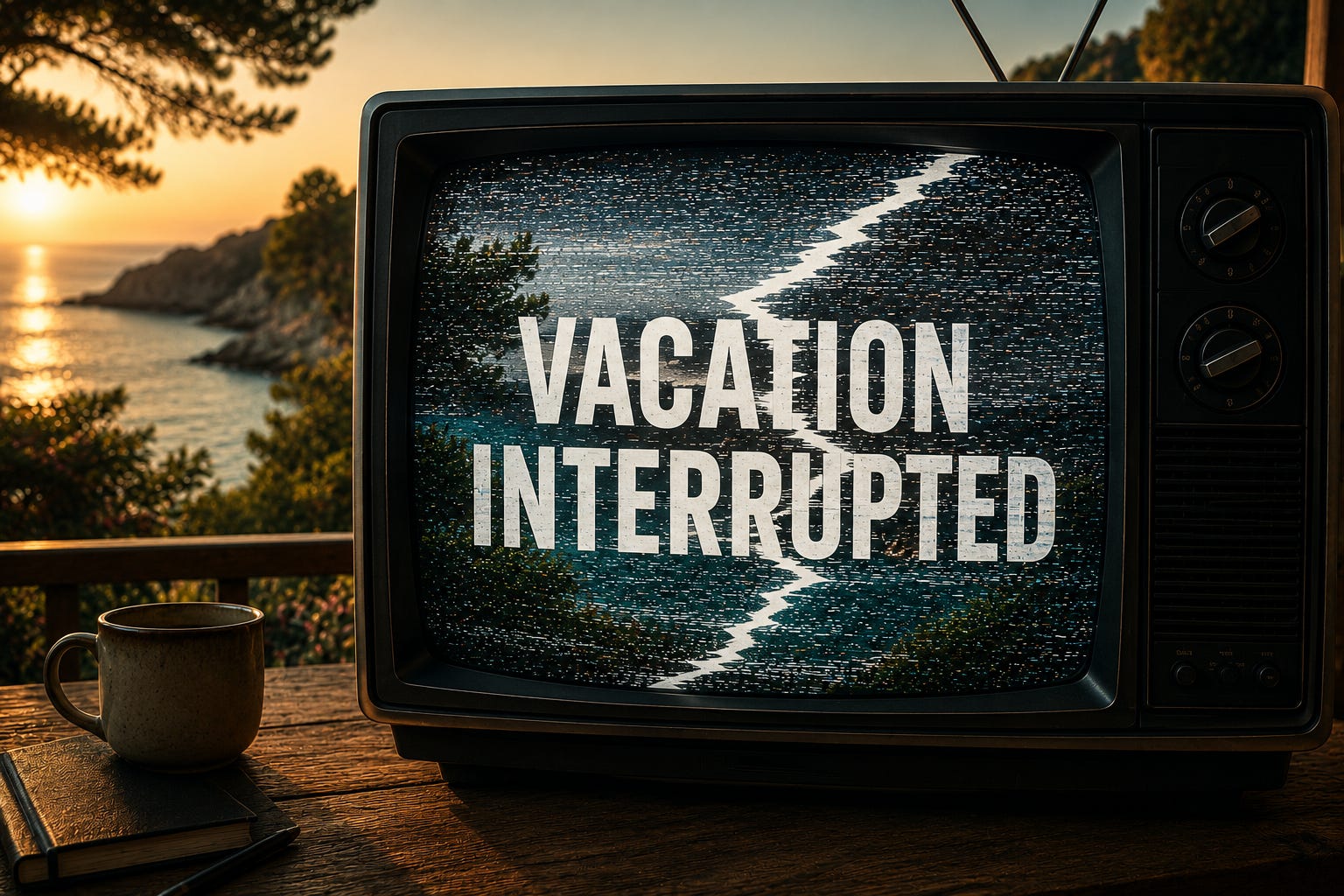
I came on vacation with the best intentions. Podcasts lined up, including This Is Love with Phoebe Judge. Hiking, cities I'd never seen, long dinners. The republic could survive a few days without my supervision.
That lasted about twenty-four hours.
Donald Trump gave another speech.
My phone lit up. Friends texted. News alerts arrived. Before long I was reading familiar allegations, familiar insinuations, familiar warnings about election integrity. I tried to ignore it, which is how I end up reading three more articles.
That evening, someone mentioned politics over dinner. I took the bait. Within minutes I had climbed onto my soapbox with the smooth efficiency of a rabbi who has clearly done this before, explaining Georgia election law to people who had simply wanted to enjoy a glass of wine. I watched their expressions shift from polite curiosity to the look people get when they're wondering whether it would be rude to fake a medical emergency.
I stopped talking.
Those poor people had not come on vacation to hear a rabbi deliver an unsolicited seminar on election administration. So I decided to write instead, which was probably better for everyone except the people reading this.
Part of the reason is simple. Georgia is not an abstract political battleground to me. It is home. I grew up there. I have spent decades serving congregations, organizing alongside people I admire, and building relationships across communities far more interesting and complicated than the cable-news version of my state. I know pastors, teachers, lawyers, election volunteers, immigrant advocates, public servants, and neighbors who disagree about almost everything except this: Georgia is worth the hard work of strengthening.
That is why I hear conversations about Georgia differently from someone watching at a distance.
Before I explain why this speech concerns me, let me say something that should not be controversial. Every election deserves scrutiny. Human beings run elections, and human beings make mistakes, sometimes while holding clipboards and wearing official badges. If someone identifies a genuine vulnerability in how we conduct elections, I want it investigated. If a weakness exists, fix it.
That is not my concern.
My concern is what happens when legitimate questions become something else.
The more I sat with the speech, the more I realized that what bothered me was not any one allegation. It was the structure of the argument.
The speech begins with questions that, on their face, deserve answers. Then, almost before you notice, the questions stop functioning as questions. They become conclusions wearing question marks like fake mustaches.
Three things stood out.
First, the speech blurred the distinction between foreign interference and evidence that votes were altered. Those are not the same thing. Influence campaigns are real and should be taken seriously. But influence is different from proof that machines changed ballots or that Georgia counted votes incorrectly.
Second, the speech repeated sweeping attacks on election administration and voting technology without offering evidence that Georgia's certified results were wrong. A possible vulnerability is not proof of theft. A loose window does not prove the house was robbed.
Third, those claims were attached to calls for significant federal action, all built on a narrative already tested through recounts, audits, investigations, and court proceedings.
None of that, by itself, explains why I interrupted my vacation.
What explains it is what comes next.
The speech is not really about election administration. Election administration is just the front door. The destination is suspicion.
Here is the problem: the argument cannot be disproved. If Trump wins, the system somehow redeemed itself. If he loses, the corruption continues. Every outcome confirms the original suspicion. The one possibility the theory cannot accommodate is that voters simply chose someone else.
It is a theory with the structural integrity of those Trump watches that arrived without the "T." The branding is loud. The quality control is less convincing.
Once you have hired the answer before the interviews begin, facts stop mattering. The conclusion was chosen long ago.
A healthy democracy works the other way around. Elections are presumed legitimate unless evidence demonstrates otherwise. That confidence is not blind faith. It comes from transparent rules, independent courts, bipartisan oversight, public audits, and a willingness to investigate serious claims wherever they lead.
Georgia did all of that.
We counted the ballots. Then we counted them again. There was a statewide hand audit, recounts, investigations, and lawsuits. Republican judges reviewed the evidence. Republican officials defended the certified results. Governor Brian Kemp and Secretary of State Brad Raffensperger concluded the evidence did not justify overturning the election.
By the end, Georgia had examined that vote so thoroughly I half expected someone to order a colonoscopy.
And still, the story survived. The audits were completed. The cases were decided. The evidence was available. Yet the claims kept going, as though the entire state of Georgia had forgotten to check its voicemail.
At some point, this stopped being an effort to discover what happened. It became an effort to preserve doubt.
I had a front-row seat to what that does to a state.
I watched Trump pressure Brad Raffensperger after the 2020 election. I watched lifelong Republicans become targets because they refused to support claims they could not prove. I watched ordinary election workers face harassment and threats for the radical act of counting ballots and reporting the total.
That is the part people outside Georgia often miss. The damage was not confined to cable news or court filings. It landed on actual people, most of whom had not volunteered to become symbols in a national crisis.
For the sake of transparency, I know Jon Ossoff and Raphael Warnock personally, and I have organized and campaigned on their behalf. Readers deserve to know that. But this essay is not about defending two politicians. Politicians can survive criticism. Democracies have a much harder time surviving the steady demolition of public trust.
I welcome hard questions. Democracies should never fear scrutiny.
What I fear are questions that have already hired the answer.
Healthy skepticism says, "Show me the evidence."
Permanent suspicion says, "Don't bother. I've already made up my mind."
Once suspicion becomes the default setting, every election begins under a cloud. Election workers begin under suspicion. Officials begin under suspicion. Institutions begin under suspicion. Eventually even victory cannot restore trust, because trust was never the objective.
I have spent enough years as a rabbi to know the difference between confession and absolution.
Confession begins with the possibility that you might be wrong. Absolution begins with the certainty that you have never been wrong. One leaves room for repentance. The other leaves room only for applause.
Maybe I am wrong. I hope I am. I would be delighted if, six months from now, we were simply having a thoughtful national conversation about improving election administration. I would happily admit my concerns were overstated. I would even do so without a footnote, which for me would represent genuine spiritual growth.
But Georgia has earned the right to recognize a pattern. We have lived through years of accusations the evidence would not sustain. We have watched public servants carry burdens they never asked for because they refused to tell powerful people what they wanted to hear. We have watched our state become a symbol in a national story that often ignored what actually happened here.
Too often, the rest of the country sees Georgia as a map colored red or blue.
I see election workers who show up before dawn because they believe every eligible voter deserves the chance to cast a ballot.
I see clergy from different faiths standing together after moments of tension because they know democracy depends on neighbors learning how to live with one another.
I see ordinary people doing the slow, unglamorous work that never becomes a headline but makes self-government possible.
That is the Georgia I know. Imperfect. Wrestling with its history every day. Still with work to do, like the rest of the country.
I will be home soon. Georgia deserves more than one essay, because Georgia has always been more complicated than the stories told about it from a distance. This one simply could not wait.
Now, if you'll excuse me, I'm going to close my laptop, put my headphones back on, and see if I can salvage what's left of this vacation before democracy sends another push notification.
Joshua I totally understand and you got pulled in because it is abominable. I will be encouraging my community members to be poll workers. Now go back and get a few more days of real vacation 💙