
The Wrong Men
What We Keep Excusing in Each Other

The event was called Ask the Rabbis.
A row of us sat on the stage. A few men. One woman. And me. One hundred and fifty people in the audience. The kind of crowd that turns out when they’ve been promised the rabbis might actually disagree with one another.
We did not disappoint.
Partway through, one of the Orthodox rabbis turned to the moderator.
“May I put a question to my colleagues?”
Polite. Almost courtly.
He’d been reading, he said, about a dissertation out of Princeton, something on marriage rituals between humans and animals. And given that progressive Judaism had decided to celebrate marriage for gay people, he wondered, with the patience of a man laying a trap and admiring his own knots—
He turned and looked at me.
What, exactly, would stop us next? If Torah no longer held us, if the only rule was love, then why not this?
You could feel the room lean in. One hundred and fifty Jews holding their breath in total silence. A medical miracle, honestly. Nobody wants the panel to turn into blood sport, and everybody, a little, does. He had asked the question kindly, which is the cruelest way to ask it.
I knew the shape of this. I had been the cautionary tale before, the slippery slope someone gestures toward to prove how far the rest of us have slid. The man one step from the animals.
My Reform colleague jumped in first, God bless her, repeating the only sane thing there was to say.
“It wouldn’t happen. I don’t know how else to put it. It just wouldn’t.”
She bought me a beat.
And in that beat, I decided to stop defending and start thinking like an Orthodox rabbi.
Here is what the third row could not see. The man who looked so composed up there had a heart going hard in his chest. There is an easy version of this story: the gentle gay rabbi and the brutish men.
It flatters me.
It also isn’t true.
I am a man.
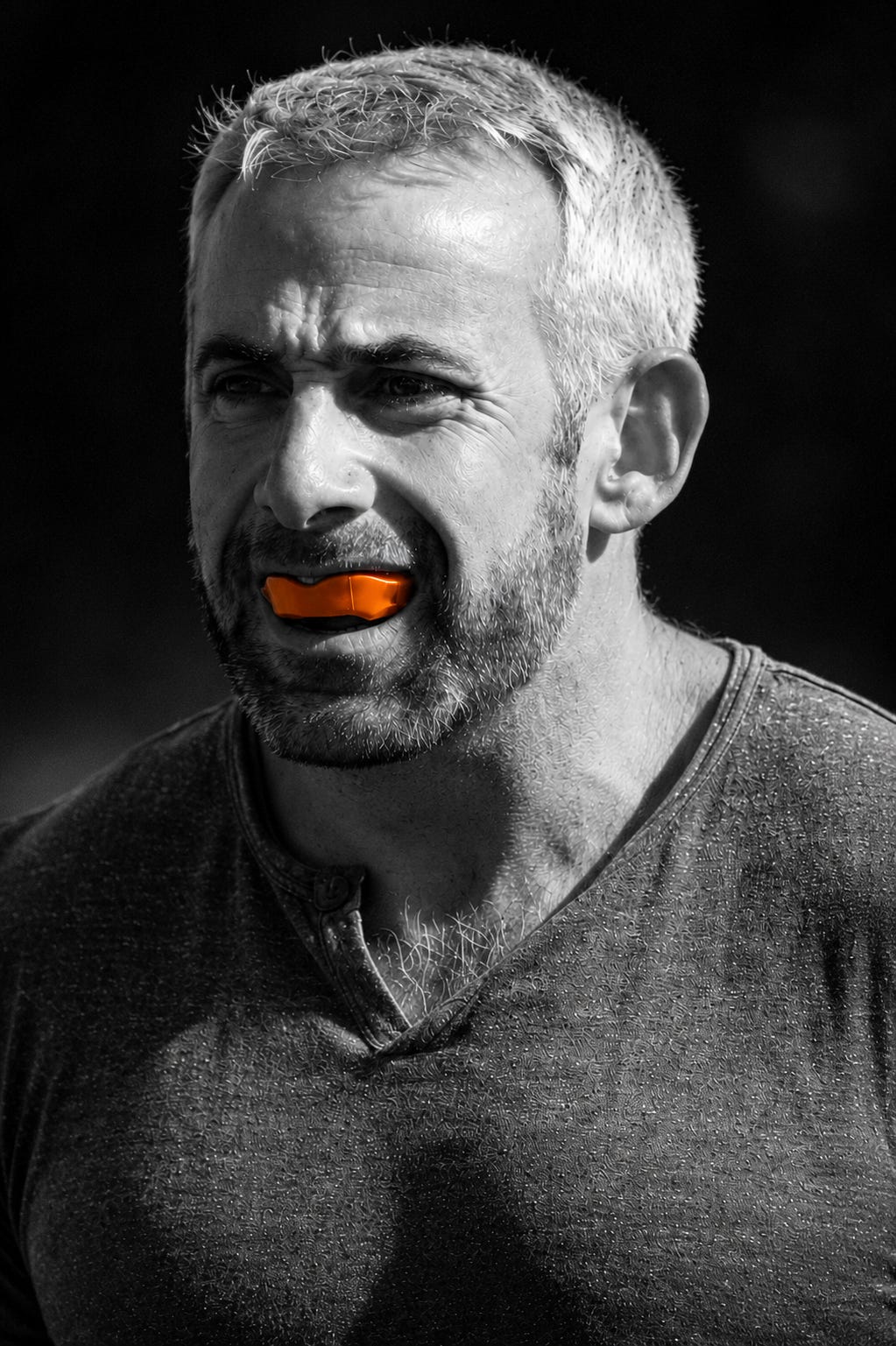
I carry the same chemistry as the rabbi who tried to humiliate me on that stage. For years, I played rugby, and I used to joke that it was the only responsible place to put everything the rabbinate asks you to swallow. All that required gentleness had to go somewhere, and I would rather it go into a scrum than into a marriage or a meeting.
Rugby, the old line goes, is a hooligan’s game played by gentlemen, which is the most honest thing anyone has ever said about masculinity. The violence and the courtesy are not opposites. They are the same men, shaking hands at the final whistle, bleeding a little, agreeing it was a good match.
I have testosterone. I have a temper I have spent decades learning to hold, not because I am gentle by nature, but because the cost of losing it was always going to be higher for me than for the men around me.
The politeness people praised in me was never quite as saintly as they imagined. Underneath it, I have swallowed derision, contempt, and more than one threat on my life. I have smiled, gone home, and had to do something with all of it.
Rugby, it turns out, was a very good place to put it.
So when I say men can do better, understand where I’m standing. Not outside the locker room with a clipboard. Inside it, muddy, same as everyone.
I have been asked to lead a wisdom circle for men. A room of Jewish men sitting together on purpose, doing the kind of work men are not generally taught to do in front of each other.
I said yes before I let myself feel how strange it was that they asked me.
Part of what made the invitation strange was that I have never quite known where I fit in the geography of gender.
Most of my life, I have found myself in rooms full of women. Some of that is the rabbinate. Some of it is being gay. Some of it is simply where my friendships have landed. I am deeply aware that women deserve spaces of their own and that my presence can complicate that. The result is that I have often felt like a traveler between worlds.
Not outside masculinity. Not entirely inside it either.
I know the locker room. I played rugby. I know competition, hierarchy, bravado, and the strange ways men test one another and protect one another. But I also know what it feels like to sit in circles where vulnerability is not treated like a contagious disease.
So when asked to build a space for men, I found myself wondering whether that was why. Not because I had mastered masculinity, but because I had spent years moving back and forth across the border.
When I saw the curriculum, I knew it needed a rewrite.
I’ve now been tasked with that.
As I sat down to build it, the revelations about Graham Platner kept arriving in waves. A new one every few weeks, each landing before the last had settled, until the whole spring started to feel like a referendum nobody had agreed to hold on what we are willing to live with in a man.
So I opened the materials I’d been handed, the curriculum that was supposed to guide the group.
The problem wasn’t that it was bad. In many ways it was thoughtful. The problem was that it assumed a starting point many men never received.
It asked participants to reflect, share, discern, and speak honestly about themselves. All worthwhile things. Essential things, really. But as I read it, I kept thinking: who taught the men how to do that?
The curriculum treated those capacities as if they were already there, waiting to be used. Many men arrive having spent decades developing entirely different skills. Competing. Performing. Providing. Enduring. Solving. Deflecting.
Some of us can rebuild an engine, negotiate a contract, coach a soccer team, survive a divorce, or quietly carry grief for twenty years. Ask us to identify what we’re feeling in real time and suddenly we’re looking for the emergency exit.
Part of what struck me was that the curriculum seemed to assume that sitting in a circle talking about yourself was a fairly natural thing to do. For many men, it is about as natural as synchronized swimming.
Maybe that’s because we keep confusing the destination with the doorway.
I’ve spent enough years as a rabbi to know that people rarely enter depth the same way. Some arrive through conversation. Others through story, music, making something with their hands, a hike, service, laughter, or simply sitting beside someone rather than directly across from them.
Many men, in my experience, need a side door into vulnerability. Give them a photograph, a poem, a memory, a problem to solve together, and suddenly they are talking about things they could never have said if you simply asked, “How are you feeling?”
The goal isn’t to avoid reflection. The goal is to create pathways into it.
A good men’s circle doesn’t begin with emotional fluency. It helps cultivate it.
I don’t say any of this to fault whoever built the curriculum. I say it because it named the problem.
We have gotten very good, in progressive spaces, at telling men what they should not be.
Men now know they should not mansplain, interrupt, dominate, suppress feelings, weaponize feelings, sit with their legs too far apart, or say “actually” with confidence. What remains somewhat unclear is what they are supposed to become instead.
We have a rich and detailed vocabulary for male failure. We are much less practiced at cultivating male wisdom.
What we have almost nothing of is a room where a man can walk in, not as a suspect, and do the work of becoming someone better without first agreeing to be ashamed that he showed up.
That was the room I was being asked to build.
The problem was that I had never seen one.
But I had questions. The same ones I have been carrying about men, including myself, for a long time.
Here is one.
Years ago, I stopped playing rugby. Not because I stopped loving it. I loved it. I stopped because of what happened after the matches.
We would play hard, shake hands, and go drink together, which is its own kind of beautiful. Rugby has always understood something important about men. We need places to put our intensity. Better a scrum than a board meeting. Better a bruised shoulder than a bruised marriage.
But more than once, men I played with got behind the wheel afterward, and more than once, men I played with got DUIs. One of them was among my closest friends.
Which is the inconvenient thing about accountability. It is much easier when the person doing the stupid thing is somebody else’s friend.
I was usually the one offering to drive. No speech about it. No flag planted. Just a hand up at the end of the night.
And at some point, I realized I did not want to belong to a brotherhood that kept choosing this. Not the drinking. The shrug.
The unspoken agreement that somebody else would handle the consequences. Somebody else would clean up the mess. Somebody else would get hurt.
Or maybe nobody would.
So I left. Without fanfare.
Which is, I have come to think, how accountability usually happens in real life. Not in a public reckoning. Not in a dramatic speech. Just a person deciding what they will and will not be part of anymore.
That question stayed with me through the curriculum, into the men’s circle, and eventually into the news.
Because while I was trying to figure out what kind of brotherhood a man would want to stay in, another question kept showing up beside it.
What kind of man are we willing to keep?
Which brings me back to Graham Platner.
This has been a strange season to be a man. A lot of ordinary men, men who have done nothing like what we are about to discuss, are walking around feeling watched, one clumsy sentence away from becoming the day’s cautionary tale. I have sympathy for that. It is not easy to be a guy who is trying and still afraid he is failing in ways he cannot see.
Graham Platner is not the ordinary man being unfairly watched.
He is the progressive nominee for United States Senate in Maine, an oyster farmer and veteran who ran as a populist and may be the party’s best chance in years at retiring Susan Collins. Good biography. Good politics. The right enemy. The kind of man a party looks at and thinks, please God, let this one be clean.
He was not.
The stories kept arriving the way bad weather arrives on the Maine coast, one system barely gone before another rolled in behind it. Explicit messages to women after marriage. Old comments about sexual assault, which he has attributed to PTSD. An accusation from a former partner that he was physically rough with her, which he denies.
I am not the courtroom, so I will not pretend to be one. Some of this he contests. Some of it he does not.
And there is the tattoo.
For years he wore a skull on his chest: a Totenkopf, the death’s-head insignia used by the SS units that guarded the concentration camps. He says he chose it drunk and young in the Marines, did not know what it was, and has since covered it.
I want to be fair to that. Young men are capable of astonishingly bad judgment. Entire industries depend on this fact. People change. Covering it is not nothing.
CNN reported that a former partner said he used to call it “my Totenkopf.” I will not pretend to know what was in his head. But a man who knew the German name for the thing knew more than a man who grabbed a skull off a wall, and the not-knowing has gotten harder to hold cleanly.
I am a Jew. I am allowed to find this hard.
Here is the part I cannot stop turning over.
None of it has sunk him.
The party has, for the most part, kept him, because the seat matters, the math is tight, and on the issues that animate the progressive heart he is exactly right. Good on billionaires. Good on workers. Good on the things we have decided are the real things.
So the question arrives quietly, which is how the important ones usually enter a room.
Is it all economics now?
Are we, the people who keep insisting that proximity to power carries moral weight, prepared to wave a man through because he is useful to us? Is the measure of a man his platform, or is it also the women who received those messages, the symbol that sat on his chest, the pattern his own wife felt she had to report?
I left a rugby team over a friend’s car keys.
I am asking what my party is willing to leave, what it is willing to keep, and whether we can still tell the difference between a principle and a price.
I want to be careful here, because it would be easy to write all of this from the dry bank, the safe man assessing the dangerous one. The truth is harder.
Listening to the people in Platner’s life describe what it was like to be close to him, I did not only feel judgment. I felt a flicker of recognition. Let me tell you why.
Last year, I was on a third date. I’d done a long run earlier, and I was off, a little hollow, a little raw, though I would not have admitted it. He had been making small judgments all evening, the kind that do not quite land, and I had been swallowing them. The food came. It was bland. I reached for the salt, and he said, with a tone, “What, you’re going to fix it without even tasting it?”
And I snapped.
I told him, sharply, that I did not appreciate being judged, that I had tasted it, and that I did not need his permission to salt my own food. Which was, on its face, fair.
What alarmed me was not what I said. It was how much was behind it. The size of the anger had almost nothing to do with the salt. I started to shake, partly the dehydration, partly something with no such excuse, in a way I am not sure I had ever shaken before. And I watched his face change. I watched him become afraid of me.
We finished the meal in near silence. We have not spoken since.
I have spent most of my life as the man other people were taught to be wary of: the gay man, the suspect, the one step from the children and the animals. What I have had to sit with since that dinner is the opposite, and more uncomfortable. Because of my work, my voice, the way I have learned to carry myself, I can be more intimidating than I know. The watched man can also be the one a person braces against. I did not lose control that night, not all the way. But I felt how close the wall was, and I understood that managing something for most of your life is not the same as being free of it.
The capacity does not leave because you have kept it on a leash. It waits to see whether you will keep holding the leash.
So let me say what I wish more men would say, out loud, to Graham Platner.
Not as enemies. As men who want him to be better than this, because we are implicated in what we tolerate in each other.
We expect more of you.
We expect real teshuvah, which is not an apology and not a press release. It is honesty about what happened, transparency about what matters, and changed behavior over time that earns back what was broken. Not the performance of contrition, but the slow, unglamorous work of becoming a man who would not do it again.
And to my own, to progressives, I have a different message.
Stop acting surprised.
Every few years we discover that a man we elevated turns out to be exactly who several people quietly warned us he was. Then we commission reports, issue statements, and talk about accountability as though the problem materialized overnight.
Do better at the front end.
Vet these men before you need them, not after the wife calls the campaign.
Stop handing power to the wrong men and then discovering, surprised, that they were the wrong men.
We are quick to talk about systems when it suits us. This is a system. We built it. We can build it better.
I know the irony of being the one to say this.
For most of my life, in rooms like these, I was the one flagged as the danger. The gay man was the suspect, the boundary case, the one step from the animals. I learned the choreography of being watched young, and I never fully put it down.
So believe me when I tell you I do not say this from above.
I say it because men have to be willing to say these things to each other before a scandal forces the conversation. We have to be willing to turn toward one another and name what we will not keep excusing, what we will not keep ignoring, and what we expect from ourselves and each other.
The men who have been let into the room have a responsibility to make the room better.
That, at least, is the room I am trying to build.
Here is why I keep saying we and not they.
Because we are all being dragged down by the worst of us. Every man who sends those messages, who keeps that tattoo, who hands the keys to the drunk friend and calls it loyalty, makes every other man a little more suspect, a little more watched, a little more alone.
The predator and the falsely accused are standing in the same rubble.
The silence that protects the first one is often the same silence that isolates the second.
So the room I want to build is not a courtroom and not a confessional. It is a place to do the work many of us were never taught how to do.
To be honest about anger, which most men are taught either to swallow or detonate, but rarely to understand.
To be honest about ambition and drive, that powerful engine that does not turn off just because we became responsible adults and that gets dangerous mostly when we pretend it is not running.
To be honest about sex. I spent part of the nineties as a safer-sex educator, and I learned then what I still believe now: you do not make men safer by shaming desire into the dark. You make men safer by bringing desire into the light, where it can be spoken about honestly among people mature enough neither to celebrate it nor fear it.
To be vulnerable without vulnerability becoming evidence.
And eventually, to put the pieces back together.
Because the man who becomes the creep, the one whose wife has to make the call, is often a man who split himself in two long before anyone else noticed. He took the parts of himself he was ashamed of and pushed them underground.
The trouble with exiling parts of yourself is that they rarely stay in exile. They get strange. They find side doors. They emerge in forms no longer under your control.
Integration is not soft work. It may be the hardest work a man does. The impulse you can sit with in a room full of men is far less dangerous than the impulse you have to hide from yourself.
And then there are the boys.
We are raising them inside a culture that increasingly treats maleness as a score. Lookmaxxing. Gym culture. Jawlines. Rankings. Optimization all the way down.
I understand the appeal better than some of my peers do. I lift weights. I played rugby. I know the satisfaction of becoming stronger. There is nothing wrong with wanting a capable body.
But somewhere along the way we handed boys a tape measure and forgot to hand them a compass.
Many of them can tell you their body-fat percentage. They can tell you where they rank on an imaginary scale of attractiveness. They can tell you how to optimize their profile, their wardrobe, their workout routine, their supplements.
What they often cannot tell you is what strength is for.
Instead, I want a room for men where strength and tenderness are not enemies, where ambition is not confused with domination, where vulnerability is not treated as weakness and desire is not treated as danger. A room where men can become more fully themselves rather than smaller versions of themselves.
And, God willing, fewer creeps.
Let me take you back to that stage, because I never told you how it ended.
The room was still leaning in. The Orthodox rabbi was still waiting, pleased, for me to either crumble or explode, which were the only two moves he had left me.
And in those seconds I decided not to defend myself at all.
I smiled at my colleague.
I said, you know what, I’ll take the bait. You’re right. In some far corner of the far left, someone could probably dream up a justification for almost anything. It’s unlikely to the point of absurd, but fine, technically, it could happen.
But we’re talking about marriage. Yes?
I grew up in this community. I attended The Hebrew Academy. I was taught early and seriously that a husband is obligated to treat his wife with care, generosity, respect, and everything Jewish ethics asks of a responsible partner.
You’d agree with that, I said.
He nodded.
Of course he did.
I turned to the crowd.
So let me tell you about the agunot, I said. The chained women. Wives whose husbands refuse to grant them a religious divorce and cannot remarry. Women left in limbo, often with children, sometimes in real poverty. I had read, just that week, about a growing number of these cases in Monsey, so I had it ready.
This is not a dissertation, I said. This is happening in observant communities right now, while we sit on this stage.
Does that represent Orthodox values? I don’t believe it does. It certainly wasn’t what I was taught. But it is being lived by real women today. So maybe, I said, the danger on the far left and the danger on the far right are closer than you’d like.
The difference between your nightmare and mine is simple.
Yours is hypothetical.Mine is happening.
I have thought about that exchange for years.
At the time, I thought we were arguing about marriage. Only while writing this did I realize we were arguing about attention.
The man on that stage wanted me to chase a monster that did not exist so we would not have to look at the people who were actually suffering. That temptation is everywhere: the Platner version, the party version, the version in my own heart.
Argue about the hypothetical man, the caricature, the slippery slope, and nobody has to sit with the actual harm done to actual people.
The women who got the messages are not hypothetical.
The chained women are not hypothetical.
The friend in the passenger seat was not hypothetical.
The harm is never hypothetical.
Only our excuses are.
And here, finally, is what I believe, the thing I want to put in front of the men in that circle and the boy I will call to the Torah this year.
We are not our roles.
The rabbi on that stage was playing one: the guardian at the gate. Platner is playing one: the nominee, the seat, the man too useful to lose. I was handed one before I could speak: the suspect, the danger, the one step from the animals.
We spend so much time defending the role that we forget the person underneath it.
But under the role, every one of us—the rabbi and the nominee and the suspect and the drunk driver and the man writing this—has a soul. Bruised, divided, capable of harm, capable of teshuvah, worth the trouble of repair.
The whole point of a room full of men telling each other the truth is to take the costume off for an hour and tend the thing underneath.
That is not soft work.
It is difficult, humbling, often embarrassing work.
It is also the only work that has ever made a man safe.
I was rarely given that room.
Most of us weren’t.
So I am going to build one. And I am going to hold the door, which is the thing I wish someone had done for me, and trust that some of the men who walk in will turn around and hold it for the next one.
That is the brotherhood worth staying in.
That is the one I refuse to leave.
Wow. I was very engaged. Thankful for this gritty and honest essay. I was… and am mindful.. so mindful … of how hard it is to have and continue to raise men. I have a couple young men that I would like to read this
Wow! Kol haKavod Rabbi Josh. This is so powerful. I read it, and then write it again. It has so many entry points and touches on so many crucial issues of our time. I'm going to share it with people in my life and hope that it will be spread far and wide as I believe what you have written will be impactful for the many who are waiting a very long time to receive these words.